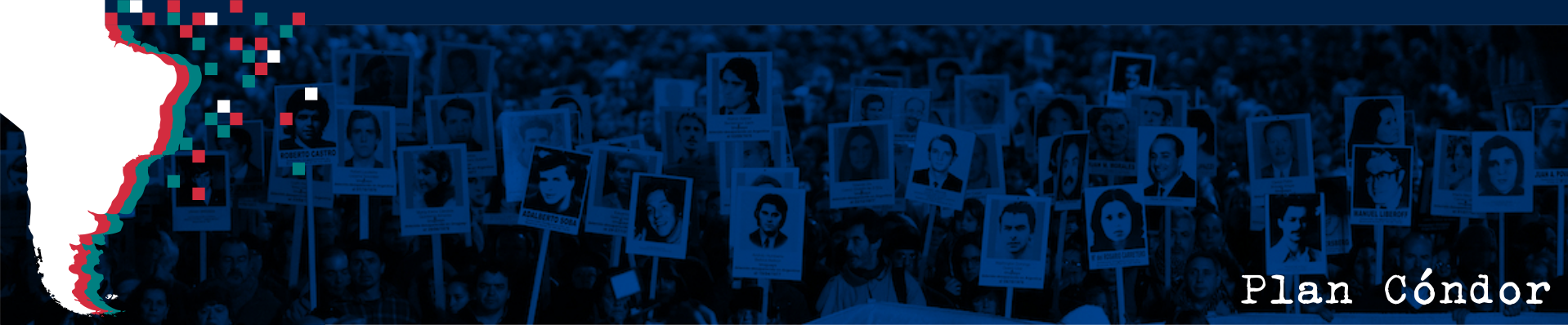
Plan Cóndor y Automotores Orletti II
Indictment of the Public Prosecutor’s Office of Argentina led by Pablo E. Ouviña and M. Mercedes Moguilansky, in Plan Condor and Automotores Orletti II- Cases 1504, 1951, 2054 and 1976.
The last ten years has seen a substantial growth in studies on political exiles, both in terms of the subjects and problems that they choose to investigate. This book is enrooted in this process since it crystallises reflections and concerns that are confluent within the field. This work brings together innovative pieces of research that were presented at the International Colloquium of Research on the Political Exiles of the Southern Cone, celebrated on 11 October 2017 at the Latin American Council of Social Sciences (CLACSO) in the Argentine capital of Buenos Aires.
This book compiles the action taken by Amnesty International to defend human rights in Uruguay during the 1970s and 1980s, particularly linked to the national and international efforts to build support networks for victims of political persecution. It develops an in-depth account of the cases of the legislators Michelini, Gutiérrez Ruiz, and Ferreira Aldunate.
This report by the Madres y Familiares de Uruguayos Detenidos Desparecidos (Mothers and Relatives of Disappeared Uruguayan Detainees) constitutes an effort to bring together the information about the disappeared detainees and the conditions of their capture that had been gathered until the report was published in 2004. It also contains information about political assassinations and the children who were appropriated and returned to their biological families.
This book explores the history of the conformation and trajectory of the fights of the Asociación Madres y Familiares de Detenidos Desparecidos de Uruguay (The Uruguayan Association for the Mothers and Relatives of Disappeared Detainees) from 1976 to 2005. The different stages in the claims for the truth to be known about the whereabouts of the disappeared detainees, both on national soil and in the region, is systematised through testimonies from the protagonists and key documents that unfold the context of the political disputes of these years and its projection onto the present.
The advising minister of the Brazilian Embassy in Buenos Aires in 1976, Marcos Camilo Cortes, reports that, former Brazilian president João Goulart’s coffin had crossed the international bridge to the Brazilian municipality of Uruguayaina and, from there, it would continue making its way to the Brazilian city of São Borja, according to the Brazilian consul in the Argentine city of Poso de los Libres. The consul added that everything had gone smoothly, including in Uruguayaina.
The advising minister of the Brazilian Embassy in Buenos Aires in 1976, Marcos Camilo Cortes, addresses the telegram to the Minister of Foreign Relations, notifying him of the arrival of former Brazilian president Goulart’s body to the Argentine city of Paso de los Libres. Cortes reports that the Brazilian consul in the city, Ney Faria, had confirmed that he had already actioned all the possible measures at his disposal but he wanted instructions from the Minister regarding the “delicate aspects of the case”.
The advisory minister of the Brazilian Embassy in Buenos Aires in 1976, Marco Camilo Cortes, addresses the telegram to the Minister of Foreign Relations to whom she sends information about the passing of former Brazilian president João Goulart. News received by the consul in the Argentine city of Paso de los Libres, Ney Faria, suggests that the former president died from a heart attack while he was in Argentina, near the locality of Mercedes.
This search request corresponds to two Argentine citizens, Ricardo Luiz Franco and Maria Catalina Benassi, who were accused of belonging to a subversive organisation called the Ejército Revolucionario del Pueblo (People’s Revolutionary Army, ERP). Franco and Benassi were both living in Porto Alegre (Brazil) at the time. The document asks for the two Argentines to be tracked down and arrested and for further relevant information to be shared.